
Last updated: September 2026
Iberia was the world launch airline for the Airbus A321XLR, becoming the first carrier to operate the new long-range narrowbody on a transatlantic route when it launched Madrid–Boston service in November 2024.
Since then, Iberia has rapidly expanded its A321XLR network. The aircraft can now be found flying from Madrid to destinations across the United States, Canada, Puerto Rico, the Dominican Republic and Brazil, including Boston, Washington, New York, Toronto, San Juan, Recife and Fortaleza.
But which Iberia routes actually use the A321XLR? What is Business Class like? Which seats are best? And how can you make sure your flight is operated by the XLR rather than an A330 or A350?
Here is the complete guide.
Iberia A321XLR Routes: Quick Answer
As of September 2026, Iberia’s Airbus A321XLR is regularly operating — or appearing on selected rotations — between Madrid (MAD) and the following destinations:
| Destination | Airport | Region | Typical A321XLR Operation |
|---|---|---|---|
| Boston | BOS | United States | Regular |
| Washington Dulles | IAD | United States | Regular |
| Newark | EWR | United States | Regular |
| New York JFK | JFK | United States | Selected rotations |
| Toronto | YYZ | Canada | Regular / seasonal |
| San Juan | SJU | Puerto Rico | Regular |
| Santo Domingo | SDQ | Dominican Republic | Selected frequencies |
| Recife | REC | Brazil | Regular |
| Fortaleza | FOR | Brazil | Regular |
Actual aircraft assignments can change depending on the date and season. Some routes are operated entirely or predominantly by the A321XLR, while others can see a mixture of the XLR and Iberia’s widebody Airbus A330 or A350 aircraft.
A snapshot of Iberia operations during August 2026 showed A321XLR flying to all nine long-haul destinations listed above, with occasional European rotations also appearing in the schedule.
Iberia now operates eight A321XLR aircraft, completing the original order that began arriving in 2024.
Iberia A321XLR Routes in Detail
Madrid to Boston – MAD to BOS
Boston was the route that started it all.
On 14 November 2024, Iberia operated the world’s first long-haul commercial Airbus A321XLR flight between Madrid and Boston.
Boston remains one of Iberia’s most important A321XLR destinations, and the aircraft has allowed the airline to increase capacity without having to operate every frequency with a larger A330 or A350.
Iberia has offered up to two daily flights between Madrid and Boston, with the A321XLR playing a major role in those additional frequencies.
For aviation enthusiasts specifically looking to try the Iberia A321XLR, Madrid–Boston is one of the safest routes to search first.
Route: Madrid (MAD) – Boston (BOS)
Aircraft: Airbus A321XLR
Approximate flight time: 8–9 hours
Madrid to Washington Dulles – MAD to IAD
Washington was the second major US destination selected for Iberia’s A321XLR.
Iberia introduced the aircraft on the route in April 2025 and subsequently turned Washington into a year-round destination, something the airline specifically credits the A321XLR with helping to make possible.
The route demonstrates one of the main advantages of the XLR: Iberia can maintain a long-haul connection without needing the capacity of a 250–350-seat widebody aircraft on every flight.
Route: Madrid (MAD) – Washington Dulles (IAD)
Aircraft: Airbus A321XLR
Operation: Year-round, although frequency varies seasonally
Madrid to Newark – MAD to EWR
One of the most interesting additions to Iberia’s A321XLR network is Newark Liberty International Airport.
Iberia launched Madrid–Newark on 29 March 2026, operating the route with the Airbus A321XLR. The new daily flight complements Iberia’s existing services between Madrid and New York JFK.
For passengers travelling to Manhattan or northern New Jersey, Newark also gives Iberia a second airport in the New York metropolitan area.
Route: Madrid (MAD) – Newark (EWR)
Aircraft: Airbus A321XLR
Typical frequency: Daily during the 2026 summer schedule
Madrid to New York JFK – MAD to JFK
Iberia’s main New York operation continues to be at John F. Kennedy International Airport, where the airline also operates larger widebody aircraft.
However, the A321XLR can appear on selected JFK rotations as Iberia adjusts capacity across its New York network.
During one operational week in August 2026, for example, Iberia A321XLR aircraft completed four Madrid–JFK round trips.
That means you should never assume that every Iberia flight to JFK is an A321XLR.
Check the aircraft and seat map for your individual flight before booking.
Madrid to Toronto – MAD to YYZ
Toronto is one of the newest destinations made possible by Iberia’s growing A321XLR fleet.
The airline launched direct flights between Madrid and Toronto Pearson on 13 June 2026, initially with five weekly frequencies.
The route was specifically planned around the Airbus A321XLR.
Toronto is a particularly good example of what the XLR was designed to do: connect two major markets where a daily large widebody might not always be necessary.
Route: Madrid (MAD) – Toronto (YYZ)
Aircraft: Airbus A321XLR
2026 schedule: Five weekly flights during the initial summer season
Madrid to San Juan – MAD to SJU
Puerto Rico has become another important market for Iberia’s A321XLR.
The airline has used the aircraft to significantly increase frequencies between Madrid and San Juan, eventually expanding the market from one to as many as two daily Iberia flights.
Not every frequency necessarily uses the XLR, however, so passengers should still check the scheduled aircraft when booking.
Route: Madrid (MAD) – San Juan (SJU)
Aircraft: A321XLR and other Iberia long-haul aircraft depending on flight and season
Madrid to Santo Domingo – MAD to SDQ
The Airbus A321XLR has also entered Iberia’s large Madrid–Santo Domingo market.
Unlike routes such as Recife or Newark, Santo Domingo is a mixed-fleet destination. Iberia can operate both A321XLR and A330 frequencies depending on the schedule.
For early 2026, several weekly Santo Domingo frequencies were specifically scheduled with the XLR alongside Iberia’s wider long-haul operation to the Dominican Republic.
If your goal is specifically to fly the A321XLR, check the seat map rather than booking solely based on the route.
Iberia A321XLR Routes to Brazil
Perhaps the most interesting expansion enabled by the A321XLR has taken place in northeastern Brazil.
Instead of limiting its Brazilian network to major markets such as São Paulo and Rio de Janeiro, Iberia can use the smaller long-range A321XLR to serve cities that would be more difficult to support with a much larger widebody.
Madrid to Recife – MAD to REC
Iberia launched nonstop flights from Madrid to Recife on 13 December 2025.
The route was designed around the Airbus A321XLR and initially launched with three weekly flights before receiving additional frequencies.
For the 2026/27 winter season, Iberia plans to operate five weekly flights, increasing to daily service during part of the peak winter period.
That makes Recife one of the most significant examples of the A321XLR opening a completely new long-haul market for Iberia.
Route: Madrid (MAD) – Recife (REC)
Aircraft: Airbus A321XLR
Region: Pernambuco, northeastern Brazil
Madrid to Fortaleza – MAD to FOR
Fortaleza joined Iberia’s network shortly afterwards, with the first flight operating on 19 January 2026.
Like Recife, the route is operated with the A321XLR.
Iberia plans further growth during winter 2026/27, with Fortaleza increasing from three to four weekly frequencies and reaching five weekly flights during part of the season.
Route: Madrid (MAD) – Fortaleza (FOR)
Aircraft: Airbus A321XLR
Region: Ceará, northeastern Brazil
These two Brazilian routes may ultimately prove to be some of the clearest examples of why airlines wanted the A321XLR in the first place: long-haul range without widebody capacity.
Does Iberia Fly the A321XLR Within Europe?
Yes — but don’t expect a permanent European A321XLR network.
Iberia has periodically operated its A321XLR on shorter European flights, both for aircraft familiarisation and normal fleet utilisation.
Before the first transatlantic service in 2024, Iberia used the aircraft on routes including Paris and Stockholm.
More recently, XLR aircraft have occasionally appeared on routes such as Madrid–Rome and Madrid–Milan.
These flights can be extremely interesting for aviation enthusiasts because they offer the possibility of experiencing Iberia’s long-haul lie-flat Business Class seat on a short European flight.
However, these rotations can change frequently and should not be treated as permanent A321XLR routes.
Iberia Airbus A321XLR Seat Map
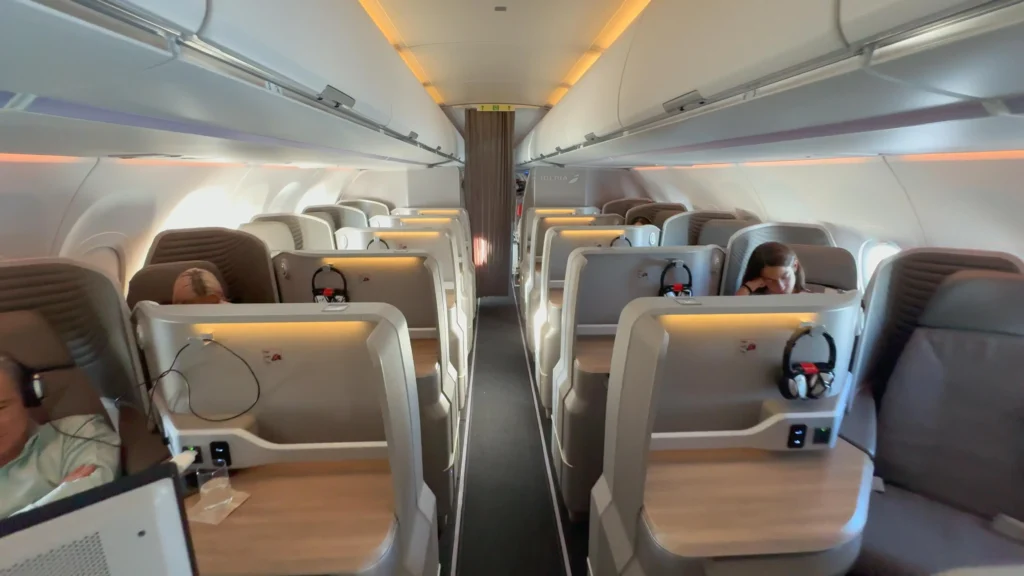
Iberia has configured its Airbus A321XLR with just 182 passengers, divided between two cabins:
| Cabin | Seats | Layout |
|---|---|---|
| Business Class | 14 | 1-1 |
| Economy Class | 168 | 3-3 |
| Total | 182 |
There is no Premium Economy cabin on Iberia’s A321XLR.
Business Class occupies rows 1–7, while Economy runs from rows 21–48.
The low seat count — especially the tiny 14-seat Business Class cabin — is one of the most unusual features of this aircraft.
Iberia A321XLR Business Class
For many passengers, the biggest question is simple:
Is Iberia A321XLR Business Class a real long-haul Business Class even though the aircraft only has one aisle?
Yes.
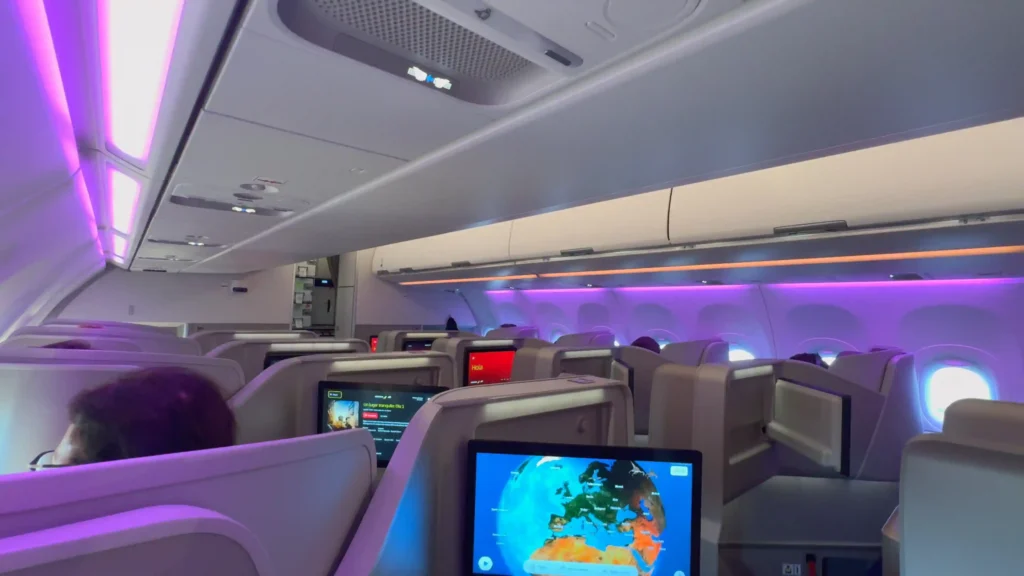
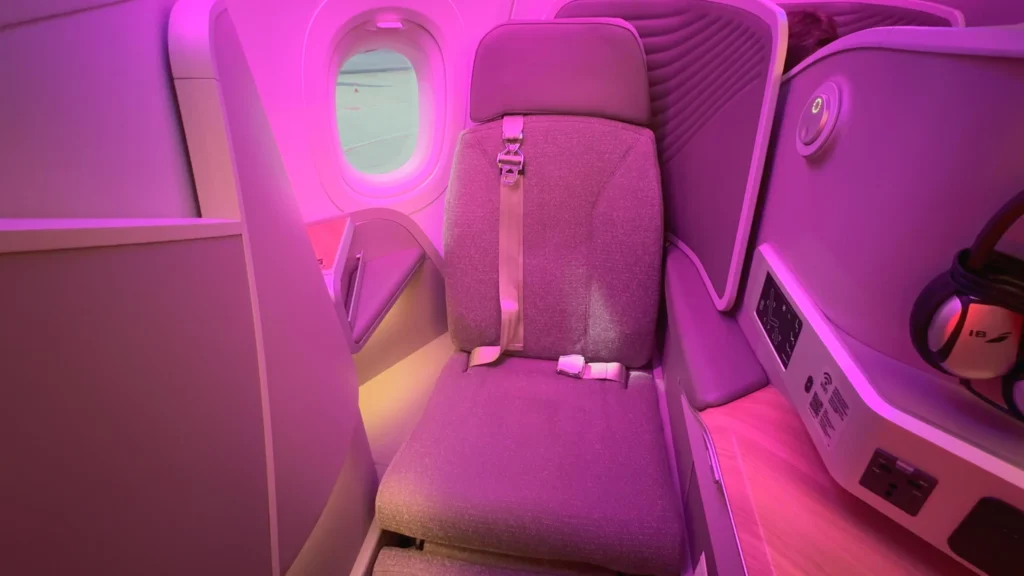
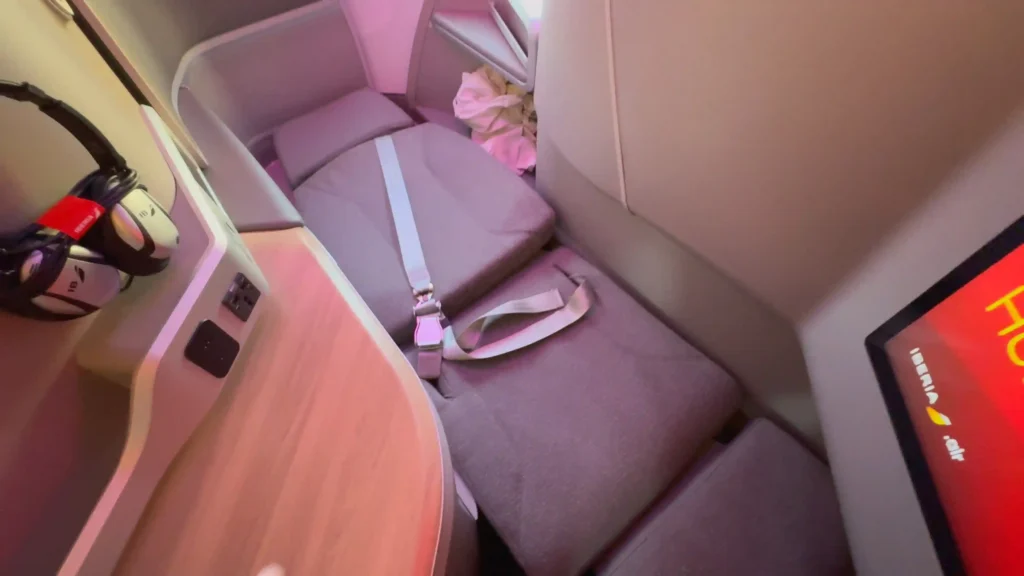
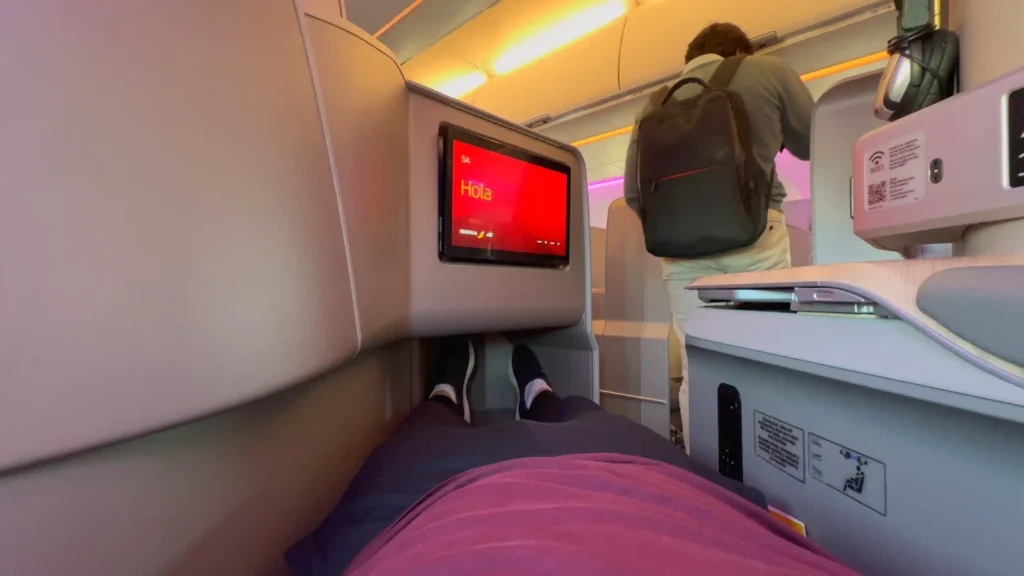
Iberia installed 14 individual Business Class seats in a 1-1 configuration, meaning every passenger gets both a window seat and direct aisle access.
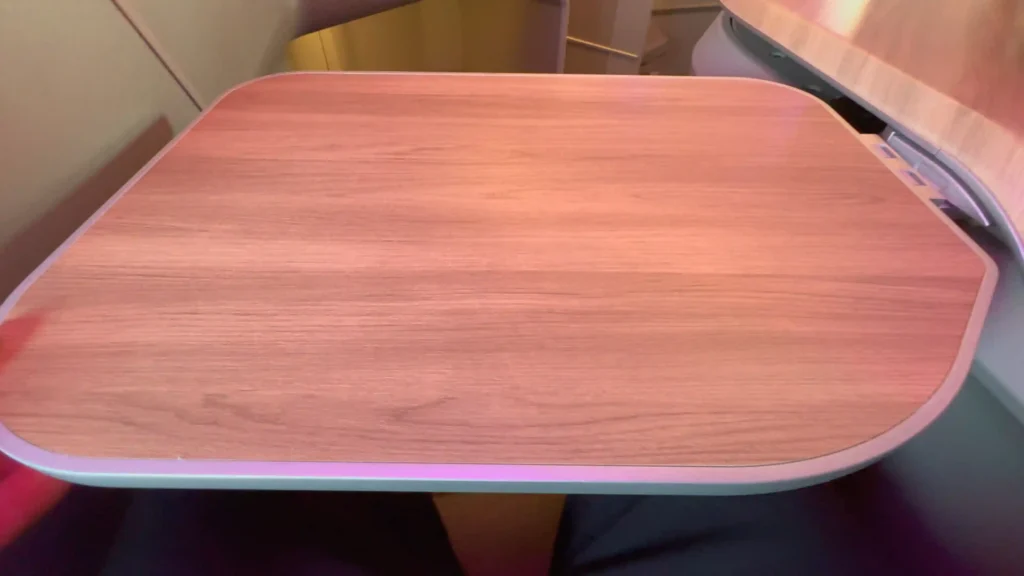
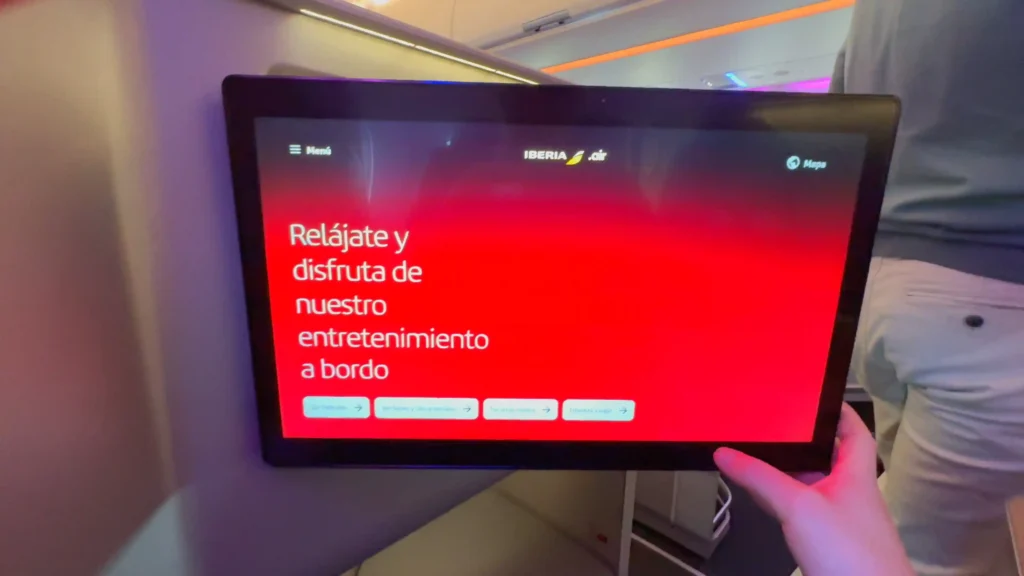
The seats convert into fully flat beds and include substantial privacy around the passenger. Iberia also equips each Business Class seat with an 18.5-inch 4K entertainment screen.
That gives the A321XLR a Business Class layout that is fundamentally different from the standard European Business Class product found on Iberia’s normal A320-family aircraft.
Iberia A321XLR Business Class features
You can expect:
- 14 Business Class seats
- 1-1 configuration
- Direct aisle access from every seat
- Fully flat beds
- 18.5-inch 4K entertainment screens
- Bluetooth connectivity
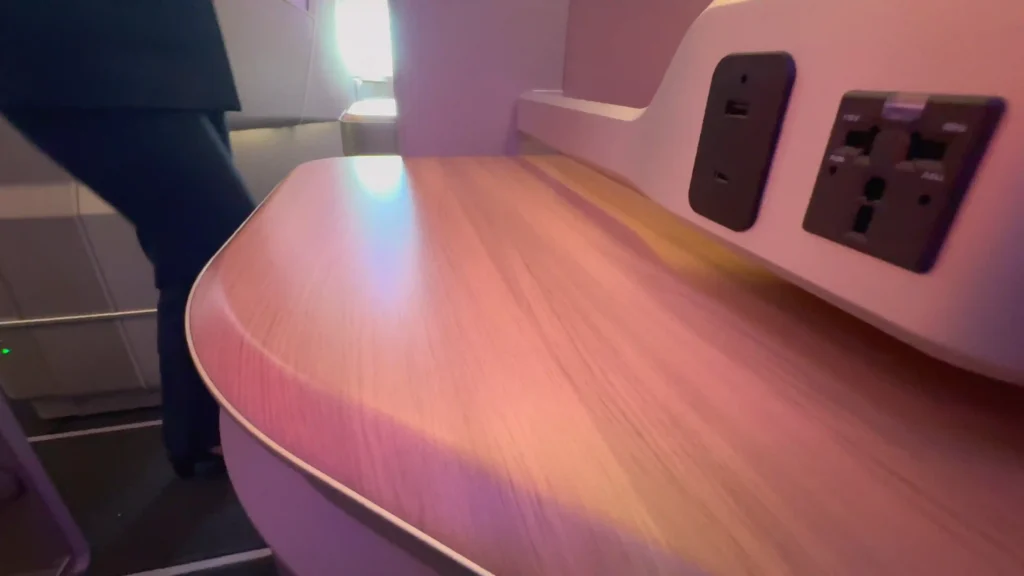
- USB-A and USB-C charging
- Individual lighting
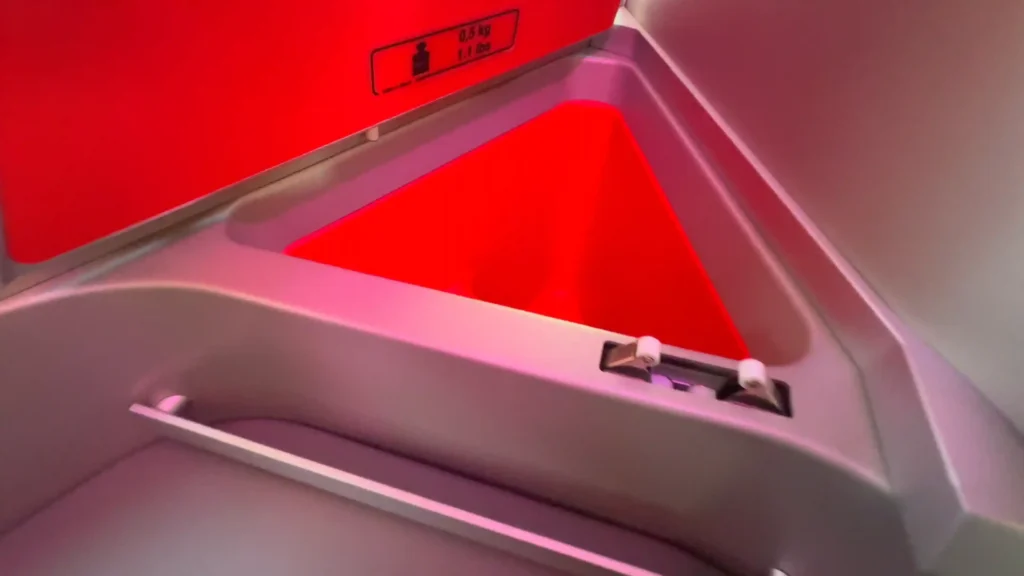
- Large Airbus Airspace overhead bins
Iberia uses the Thompson Aero VantageSOLO seat, a product specifically designed to provide a long-haul Business Class experience inside a narrowbody aircraft.

What Are the Best Business Class Seats on the Iberia A321XLR?
There are only seven rows in Business Class, with one seat on either side of the aisle.
For most passengers, rows 2–6 are the safest choices.
They keep you away from the very front of the cabin and generally provide a quieter middle-cabin position.
Row 1 has some unique characteristics due to the bulkhead and seat design, while row 7 places you closer to the Economy cabin and activity around the rear of Business Class.
There are no paired centre seats, so couples cannot sit directly next to each other as they can in the centre section of an A350.
The trade-off is that every Business Class passenger receives a window and aisle access, something even many widebody Business Class cabins cannot offer.

Iberia A321XLR Economy Class
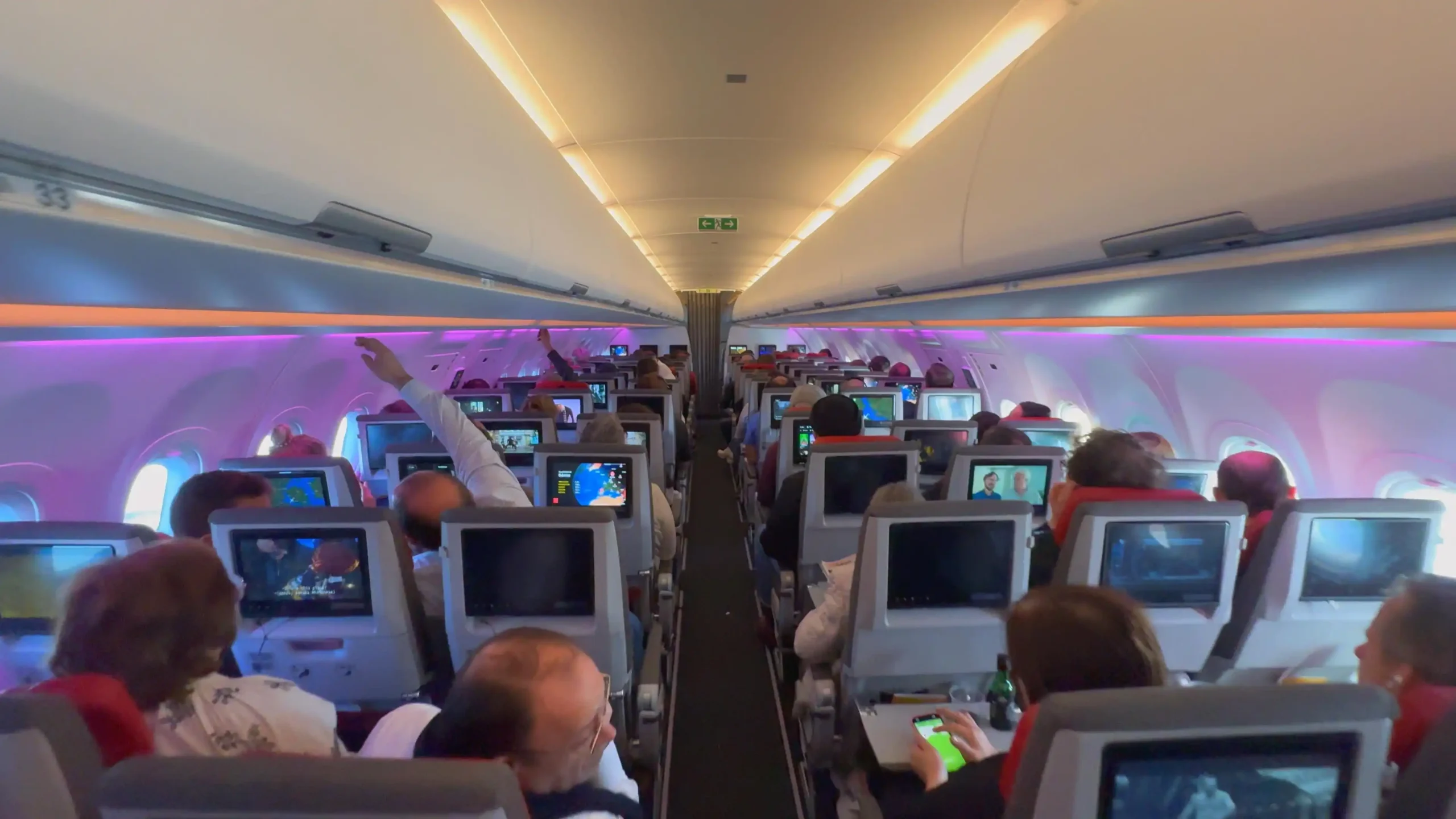
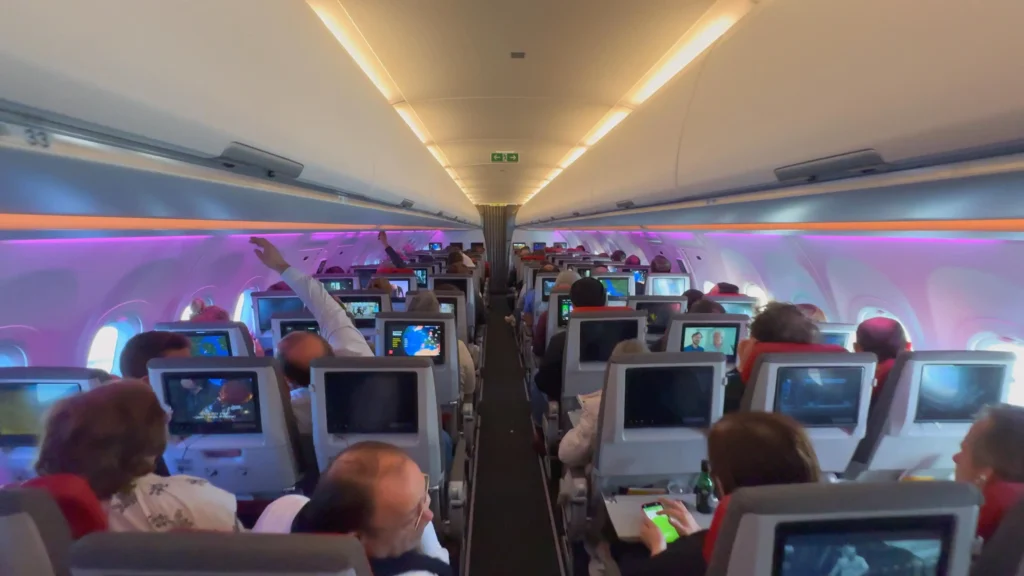
Behind Business Class are 168 Recaro CL3810 Economy seats in a conventional 3-3 layout.
This is where the difference between the A321XLR and a widebody aircraft becomes much more noticeable.
There are only six seats across and a single aisle, meaning the cabin feels much closer to a normal European A321 than an A350.
However, Iberia has equipped the aircraft as a genuine long-haul product.
Each Economy seat has:
- A 12-inch 4K entertainment screen
- Bluetooth audio connectivity
- USB-A charging
- USB-C charging
- Adjustable headrest
- Up to four inches of recline
- Seatback storage
The aircraft also uses Airbus’ Airspace interior, including larger overhead bins with up to 60% more hand-luggage capacity than previous-generation Airbus narrowbody bins.
Best Economy Seats on the Iberia A321XLR
Seat selection matters considerably more on an eight- or nine-hour narrowbody flight than on a short European sector.
The most interesting seats are around the emergency exits.
Row 29 is particularly attractive because it offers significantly more legroom while retaining recline.
Row 28 also offers considerable extra space, although the seats do not recline.
The front Economy bulkhead at row 21 is another option for passengers prioritising legroom.
Passengers may want to think twice about row 27, which sits immediately ahead of the exit and does not recline, while the final rows place you close to the rear galley and toilets. Independent cabin measurements place rows 28 and 29 at approximately 40 and 39 inches of pitch respectively.
For a long transatlantic flight, I’d prioritise row 29 if available.
Does Iberia A321XLR Have Premium Economy?
No.
Iberia’s A321XLR has only two cabins:
Business Class and Economy Class.
That differs from some Iberia A350 and A330 long-haul aircraft, where Premium Economy is also available.
If Premium Economy is important to you, check the aircraft carefully before booking.
Does Iberia A321XLR Have Wi-Fi?
Yes.
Iberia’s A321XLR was introduced with onboard connectivity, including complimentary messaging for eligible passengers.
Iberia is also in the process of rolling out Starlink high-speed Wi-Fi across its fleet, with deployment beginning in 2026. The airline says Starlink will ultimately provide free high-speed internet in every cabin, but the rollout is progressive, so not every A321XLR should be assumed to have Starlink installed yet.
How Far Can the Iberia A321XLR Fly?
Airbus designed the A321XLR specifically for routes that were previously difficult to operate economically with narrowbody aircraft.
Airbus quotes a maximum design range of up to 4,700 nautical miles, depending on aircraft configuration and operating conditions.
Iberia quotes approximately 7,500 kilometres — around 4,050 nautical miles — in its own configuration.
That is enough range to connect Madrid with the US East Coast, Canada, the Caribbean and parts of northeastern Brazil.
And that is exactly how Iberia is using it.
Is the A321XLR Comfortable for an 8-Hour Flight?
This will depend heavily on your cabin.
In Business Class, the XLR can actually offer some advantages compared with larger aircraft. The cabin contains just 14 passengers, every seat has both direct aisle access and a window, and the seat converts into a fully flat bed.
In Economy, the debate is more complicated.
The seat itself is designed for long-haul flying and includes modern entertainment, charging and an adjustable headrest. But you are still spending potentially eight or nine hours inside a single-aisle 3-3 cabin.
That means a narrower aisle, more potential congestion during meal service and fewer opportunities to move around than on an A330 or A350.
The XLR provides the range of a long-haul aircraft.
It does not magically turn an A321 fuselage into an A350.
A321XLR vs A350: Which Is Better?
The answer depends on what matters most to you.
In Business Class
Iberia’s A321XLR is surprisingly competitive.
Both aircraft offer fully flat seats and direct aisle access.
The XLR has an unusually intimate 14-seat Business Class cabin, while Iberia’s A350 provides considerably more cabin space and the atmosphere of a true widebody.
In Economy
The A350 has the clearer advantage for most passengers.
The wider fuselage, twin aisles and larger cabin generally make it easier to move around during a long flight.
On the A321XLR, Economy is still arranged 3-3 around one aisle.
So if two otherwise identical flights were available at the same price, many Economy passengers would probably prefer the A350.
But that misses part of the point of the XLR.
Many of the routes Iberia operates with it — particularly Recife, Fortaleza and Newark — either did not exist before or can now support additional frequencies precisely because Iberia does not need to fill an A350.
How to Tell if Your Iberia Flight Is an A321XLR
Iberia can change aircraft, so always check your specific flight before booking.
The easiest clue is the seat map.
Look for this in Business Class:
1-1 seating across seven rows = A321XLR
There should be just 14 Business Class seats, with one seat beside each window.
By comparison, Iberia’s A330 and A350 long-haul aircraft have considerably larger Business Class cabins with seats arranged across a wider fuselage.
Do not rely exclusively on an aircraft code such as 32Q, because airline reservation-system equipment codes can sometimes cover aircraft within the broader A321neo family.
The combination of:
Airbus A321XLR + 14 Business seats + 1-1 configuration
is a much more useful check.
And remember: aircraft assignments can still change before departure.
Can You Book Iberia A321XLR Business Class With Avios?
Yes.
Iberia A321XLR flights can be booked using Iberia Club Avios, subject to award availability.
The difficulty is Business Class capacity.
An Iberia A350 can carry many more Business Class passengers, while the A321XLR has only 14 Business Class seats in the entire aircraft.
That means finding multiple award seats on the same XLR flight can be challenging.
Rather than relying on an old fixed Avios chart, search your exact travel dates through Iberia because award pricing and availability can change.
If you are specifically trying to experience the A321XLR, check the aircraft assignment before transferring points or completing your booking.
Why Is Iberia Using a Narrowbody Across the Atlantic?
The A321XLR isn’t intended simply to replace every A330 and A350.
Its biggest advantage is flexibility.
A large widebody makes sense when hundreds of passengers want to travel on the same flight.
But imagine a route where there is enough demand for 180 passengers — but not 300.
Previously, an airline might have had to choose between operating a large aircraft with too much capacity or not operating the route at all.
The A321XLR changes that calculation.
Iberia can use its 182-seat aircraft to:
- Open new long-haul destinations
- Increase frequencies on existing routes
- Serve thinner transatlantic markets
- Operate year-round routes that might previously have been seasonal
- Save larger A330 and A350 aircraft for higher-demand destinations
Iberia itself has highlighted Boston, Washington and San Juan as examples where the aircraft has supported additional frequencies or year-round flying, while Recife and Fortaleza demonstrate its ability to open new markets.
Iberia A321XLR Specifications
| Specification | Iberia Airbus A321XLR |
|---|---|
| Total seats | 182 |
| Business Class | 14 |
| Economy Class | 168 |
| Business layout | 1-1 |
| Economy layout | 3-3 |
| Business seat | Thompson Aero VantageSOLO |
| Business bed | Fully flat |
| Business IFE | 18.5-inch 4K |
| Economy IFE | 12-inch 4K |
| Economy seat | Recaro CL3810 |
| Iberia quoted range | Up to 7,500 km |
| Engines | CFM LEAP-1A |
| Premium Economy | No |
| Bluetooth IFE | Yes |
| USB-A / USB-C | Yes |
Iberia’s own specifications confirm 182 seats, the 14/168 cabin split, its 7,500-kilometre range and the long-haul cabin equipment.
Iberia A321XLR FAQ
Where does Iberia fly the A321XLR?
As of September 2026, Iberia’s A321XLR is regularly operating or appearing on selected flights from Madrid to Boston, Washington Dulles, Newark, New York JFK, Toronto, San Juan, Santo Domingo, Recife and Fortaleza. Aircraft assignments and frequencies vary by season.
Does Iberia fly the A321XLR to New York?
Yes. Iberia operates its Madrid–Newark route with the Airbus A321XLR, and the aircraft can also appear on selected Madrid–JFK services.
Does Iberia fly the A321XLR to Brazil?
Yes. Iberia operates the A321XLR nonstop from Madrid to Recife and Fortaleza in northeastern Brazil.
Does Iberia fly the A321XLR to Canada?
Yes. Iberia launched Madrid–Toronto A321XLR flights in June 2026 with five weekly frequencies during the initial season.
How many seats does the Iberia A321XLR have?
Iberia’s A321XLR has 182 seats: 14 in Business Class and 168 in Economy.
Does Iberia A321XLR Business Class have lie-flat seats?
Yes. All 14 Business Class seats convert into fully flat beds and have direct aisle access.
Does the Iberia A321XLR have Premium Economy?
No. Iberia configures the A321XLR with only Business Class and Economy.
Is Iberia A321XLR Business Class 1-1?
Yes. There is one Business Class seat on either side of the aisle, giving every Business Class passenger both a window seat and direct aisle access.
What are the best Economy seats on Iberia’s A321XLR?
Rows 28 and 29 offer additional legroom around the emergency exits. Row 29 is particularly attractive because it combines extra space with the ability to recline.
How can I know if my Iberia flight is an A321XLR?
Check the aircraft information and seat map. An Iberia A321XLR has just 14 Business Class seats arranged 1-1 across seven rows, followed by a 3-3 Economy cabin.
Can Iberia change the A321XLR for another aircraft?
Yes. Aircraft assignments are never guaranteed. On routes where Iberia uses several aircraft types, an A321XLR can potentially be replaced by an A330 or A350 before departure.
Final Thoughts: The A321XLR Is Changing Iberia’s Long-Haul Network
The most important thing about Iberia’s A321XLR isn’t simply that a narrowbody can cross the Atlantic.
It is where Iberia can fly because of it.
Boston can support additional frequencies. Washington can operate year-round. New York now has an additional Iberia gateway at Newark. Toronto has gained a nonstop Iberia connection. And cities such as Recife and Fortaleza can have direct links to Madrid without requiring the capacity of an A330 or A350.
For passengers, the experience depends heavily on where you sit.
In Business Class, the tiny 14-seat 1-1 cabin, direct aisle access and fully flat seats make the A321XLR a genuinely premium long-haul aircraft.
Economy is a different proposition: the entertainment and seat technology are modern, but ultimately you are still crossing the Atlantic in a 3-3, single-aisle cabin.
Either way, the A321XLR is becoming an increasingly important part of Iberia’s network — and with eight aircraft now in the fleet, it is no longer a novelty that appears on one or two routes.
It is becoming a core part of how Iberia connects Madrid with the Americas.